The DA Sander and the End of Hand-Sanding
The Scent of Dust and Oil
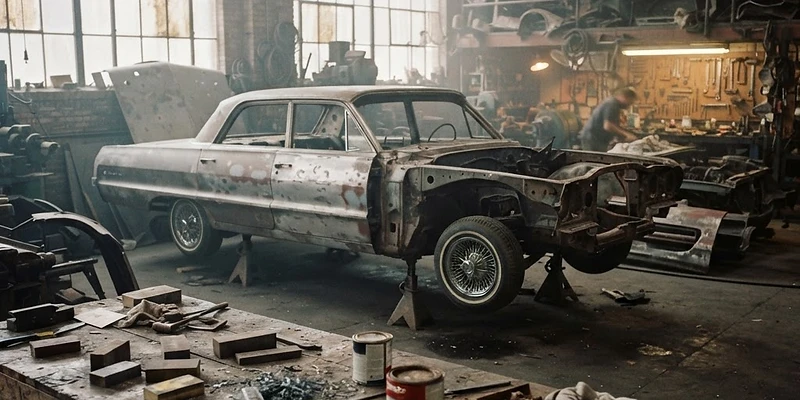
The air in a shop before the 1970s carried a specific, heavy weight—the suspended particles of lead-based body filler and the persistent, sweet tang of lacquer thinner. Before the ubiquity of pneumatic power, the restoration of a damaged fender was a tactile, exhausting ritual. You could hear the rhythmic, raspy shucking of sandpaper against steel, a sound that defined the labor of a generation of body men who spent their days hunched over metal, their palms calloused from long wooden sanding blocks.
The Anatomy of the Hand-Sanding Era
Restoration in the mid-century era was defined by the block. Whether using a flexible rubber block to contour a wheel arch or a rigid length of kiln-dried pine for the flat, sweeping panels of a Detroit sedan, the process was entirely manual. Craftsmen worked in stages, moving from coarse 36-grit open-coat paper to finer grades, manually 'cross-hatching' the surface to ensure flatness. It was an exercise in patience and muscle memory. The limitation was not just speed, but human fatigue; by late afternoon, the pressure applied to the block inevitably grew inconsistent, leading to 'waves' in the metal that only a perfectly lit paint booth would reveal.
The Rise of the Dual Action
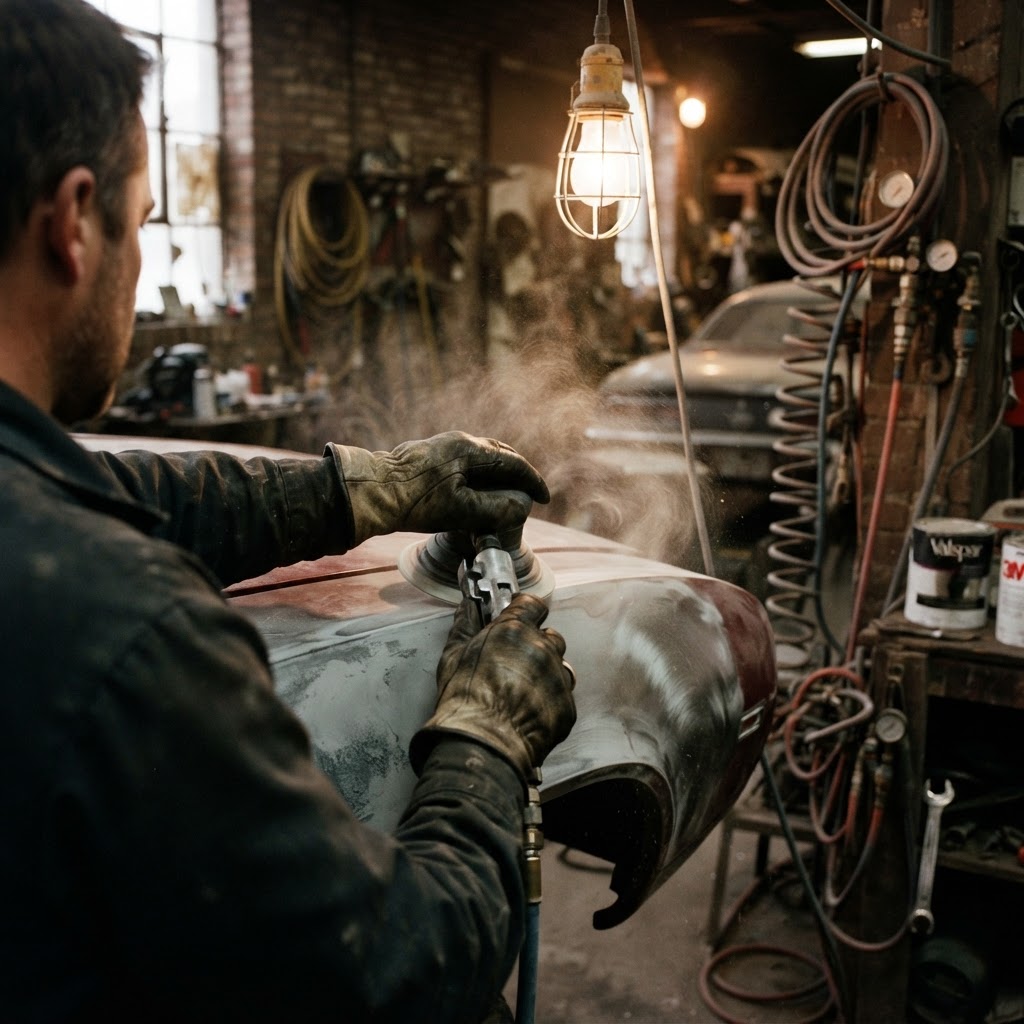
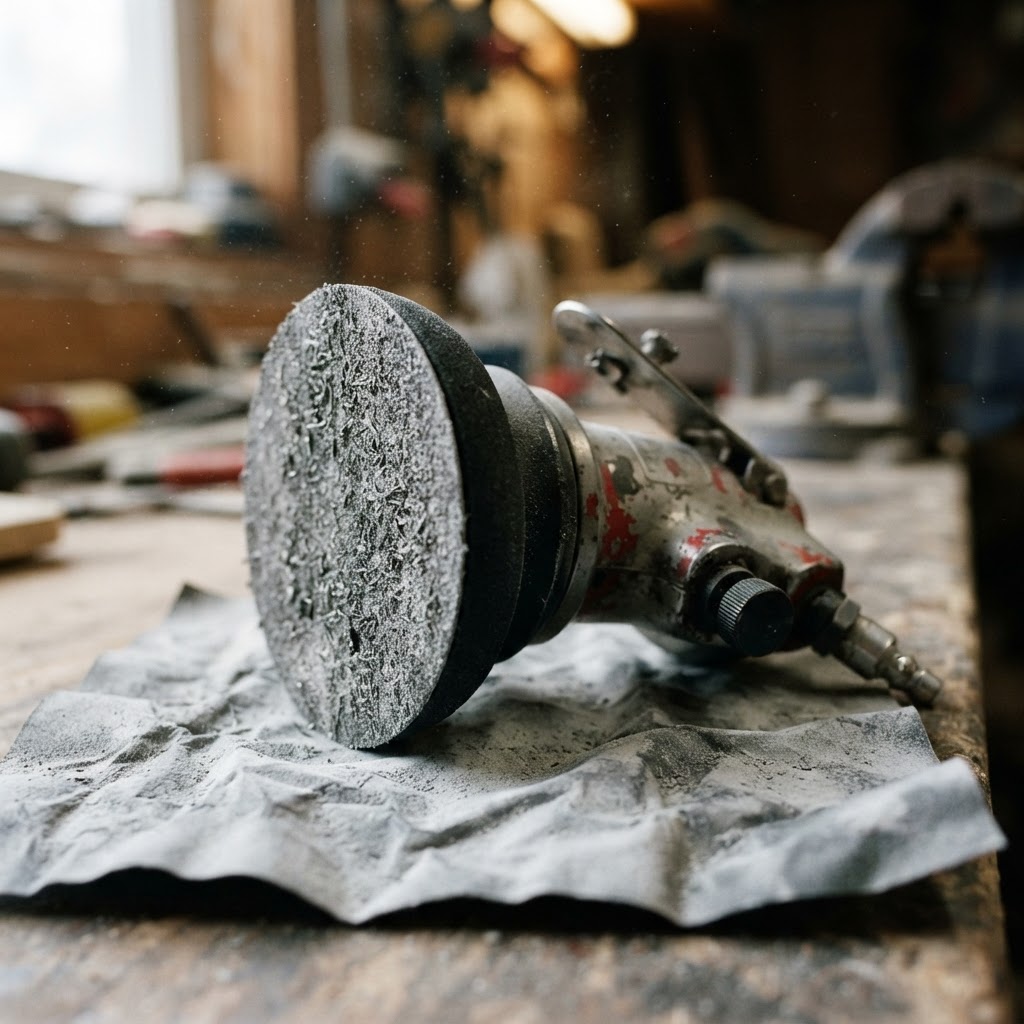
The introduction of the pneumatic Dual Action (DA) sander—first gaining traction in professional bodyshops in the late 1960s and 1970s—changed the chemistry of the repair. The DA sander operates on a dual-motion principle: a circular rotation combined with a random orbital oscillation. This was a revolution in abrasive physics.
Why the DA Changed Everything
- Eliminating Pigtails: By adding a random orbital component to the rotation, the DA prevents the deep, concentric scratches that a pure rotary grinder leaves behind, which often burned through thin sheet metal.
- Heat Dissipation: The oscillation keeps the abrasive moving across the surface, preventing the localized friction heat that causes plastic body fillers to soften or paint to 'load up' and clog the paper prematurely.
- Material Consistency: Because the tool provides consistent downward force and constant oscillation, the technician can achieve a level of flatness in body filler that is physically impossible to maintain by hand alone.
Refining the Finish
The transition to the DA required a change in materials as well. The era of the 1980s saw the widespread move toward two-part polyester body fillers, which set harder than the lead-based solders of the 1950s. Hand-sanding these modern, catalyzed plastics would have been an exercise in futility. The DA allowed technicians to cut through these harder compounds with efficiency, leveling the contours of a car body in minutes rather than hours. The process typically followed this sequence:
- Rough Cut: Shaping the heavy buildup of filler with 80-grit abrasive on the DA.
- Surface Leveling: Moving to 120-grit or 180-grit to blend the filler into the surrounding factory steel.
- Priming: Applying a high-build primer-surfacer to seal the porous filler.
- Final Blocking: A brief, light hand-sanding with 320-grit to confirm the surface profile before the final basecoat is applied.
Modern Practice and the Old Guard
While the DA sander shifted the heavy lifting away from the human hand, the essential knowledge of the old school remains vital. A machine is only as good as the technician holding it. The modern practitioner still relies on the 'feel'—the way the sander vibrates against a high spot or the way the surface sounds when it transitions from filler to steel. We have traded the physical toll of hand-sanding for the precision of pneumatics, but the ability to read the topography of a car panel remains a craft that no motor can replicate. Today, we use the DA to work faster, but we use the old-fashioned block to finish the job with the same soul that defined the shops of 1985.